If you want to know how to organize a small bathroom on a budget, the first step costs nothing: take things out. Storing before sorting just moves clutter into nicer containers, and in a bathroom that usually means a crowded cabinet where you still can’t find anything. Buy last, not first.
Empty every surface, drawer and cabinet onto a towel on the floor or the bed. Sort it all into four piles: use daily, use weekly, use rarely, and bin. The bin pile is usually bigger than people expect. Expired sunscreen, dried-out mascara, hotel miniatures you never opened, and the third nearly empty bottle of the same shampoo can all go. Keep one of each regularly used product in the prime spots. Backups can live in a hall closet or a lidded box elsewhere.
Next, map the room. With a tape measure and a notepad, note the free wall space above the toilet, the clear height and width inside your vanity (watch for pipes), the back of the door, and any blank wall beside the mirror. Write the numbers down. Most budget mistakes happen when someone buys a shelf two centimetres too wide. Then think about who uses the room and how. A household of one has different needs than a family sharing a single sink, and a renter who can’t drill needs a different shopping list than an owner who can. That’s my own planning advice rather than a sourced rule, but it prevents the most common waste: organizers that don’t fit your habits.
Finally, set a total budget before you browse. Pick a cap you’d be happy to lose if one item turned out wrong. Decide it now and you’ll shop with more discipline later.
When floor space runs out, the walls do the work. Budget guides keep landing on the same advice: use floating shelves, wall racks and over-the-door hooks, as this roundup of small-bathroom budget ideas points out. It works because the space at head height is almost always empty while the countertop is overloaded.
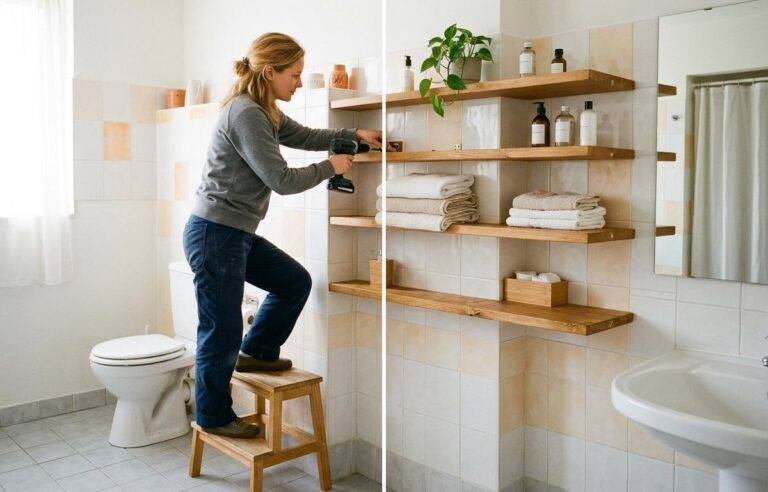
Over the toilet. This is the most recommended spot, and for good reason: it’s dead space that costs you no footprint. If you can’t drill, a freestanding over-the-toilet unit is the sensible choice, as Sunday’s small-bathroom storage guide notes. If you can drill into a solid wall, a pair of shelves gives you more flexibility. Our guide to bathroom over-toilet shelves covers heights and safe installation.
Wall racks and shelves. On a narrow wall beside the mirror, a slim rack holds daily things: toothbrushes, a hairbrush, a small plant. Keep daily items at roughly shoulder height and push heavier or rarely used things lower. To compare formats, see our overview of bathroom shelves and the walkthrough on shelf height, depth and a safe install before you buy.
Shower area. Wet storage needs its own thought. A corner caddy or stick-on shelf keeps bottles off the tub edge and cuts the soap-scum ring that forms beneath them. See how to choose shower shelves that fit if you’re weighing options.
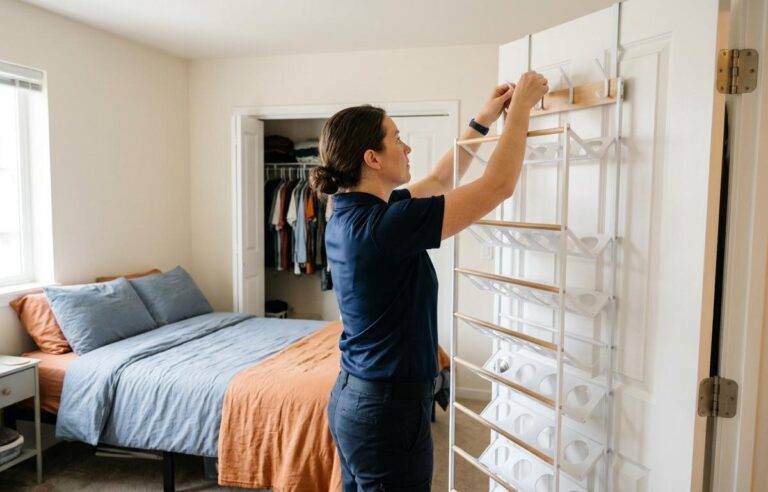
Doors and magnets. The back of the door is free real estate. Over-the-door hooks take towels, robes and hair tools with no screws. Magnetic strips are another cheap trick: One Home Therapy suggests them for metal grooming tools like tweezers, nail clippers and bobby pins, which keeps them visible and off the counter.
One rule of thumb from my own experience, not a sourced standard: picture the shelf in place first, then check clearance for your tallest bottle, your head when seated, and the toilet lid when it’s open. If any of those fail, adjust before buying.
The cabinet under the sink is where budget organizing pays off fastest, because the fixes are mostly free. Before you buy a single bin, look at what’s already in the house.
Houzz suggests browsing kitchen, craft and food-storage aisles for containers, and that applies to your own cupboards first. Houzz’s budget bathroom guide notes that these aisles often have better, cheaper options than the dedicated bathroom section. Clean jam jars, takeaway tubs, a mug, a shoebox lid or a drinks crate can all do the job.
What should I store under my bathroom sink? Whatever you use less than daily but more than once a month: spare toilet paper, cleaning supplies, backup toiletries, hair tools, first-aid basics. Keep anything toxic, such as bleach, drain cleaner and medicine, on a high shelf or in a latched cupboard if children or pets are around. Put the things you reach for most at the front.
Some practical ways to make the space work:
A moisture warning, again my own advice: fabric bins, untreated wicker and cardboard hold dampness and can go mouldy under a sink where pipes sweat or leak. Prefer plastic, metal or glass, and wipe the cabinet floor now and then. If you do use a basket, keep it on a drier upper shelf, not the cabinet floor.
If the space is genuinely tiny, our guide to home organization ideas for small spaces has tricks that carry over from other rooms.
Here’s a realistic way to think about spend. One source breaks small-bathroom storage into bands, with options in the $0 to $50 range and storage carts at roughly $40 to $80, according to College City Design Build. Treat those as ballparks, not quotes; prices vary by retailer and region, so check before you commit.
For a sense of what’s out there, CNN Underscored’s 2026 under-$50 roundup listed an under-sink tiered organizer two-pack at around $24 to $26. That’s an example, not a recommendation, and the price will have moved by the time you read this.
How can I add storage to a small bathroom without drilling? This is the renter’s question, and there are several answers:
For more storage pieces to browse, the space-saving furniture category and our home care collection are worth a look, and a guide on how to choose home storage organization products helps you weigh cost against how often you’ll actually use something.
A worked budget example (my own illustration, not a sourced figure). Say you buy a freestanding over-the-toilet unit, a two-tier under-sink organizer, a set of over-the-door hooks and a magnetic strip. At mid-range prices you can stay comfortably under the $80 cart price band by skipping the cart and putting the money where your biggest problem is. Add up your own local prices and compare against your cap.
Cost per use is the real test. A $25 organizer you reach for every morning beats a $10 basket that never fits. Before buying, ask how many times a week the thing will earn its place. If the answer is "rarely," skip it.
What is the best storage solution for a very small bathroom? There isn’t one winner. The best single move is usually vertical storage above the toilet, paired with a decluttered, well-contained cabinet. Start there and add only what you still need.
An organized bathroom stays organized only if the system is easy to maintain. Build a few habits and you won’t have to redo the whole project every season.
Put things away immediately. The most common advice across home organization sources is also the least glamorous: return items to their home right after use. It takes seconds and prevents the counter pile-up that sends people back to square one.
Do a quick monthly sweep. Once a month, check expiry dates, toss empties and wipe the shelves. Once a season, repeat the full empty-and-sort from the first step. Little and often beats a big annual purge.
Manage moisture. Bathrooms are damp, and storage that traps humidity breeds mould. Choose water-resistant materials such as plastic, coated metal, glass or sealed wood. Leave a small air gap behind baskets, run the fan or open a window after showers, and don’t stack damp towels in closed bins. If a fabric or wicker bin starts to smell musty, retire it from the bathroom. This is general home-care advice, not a researched finding, but it protects your investment.
Think about reach heights. Many budget guides skip this, yet it matters for older adults, caregivers and anyone with limited mobility. Keep daily-use items between roughly hip and shoulder height so there’s no stooping or stretching. Avoid putting heavy or frequently used things on the very top or bottom shelf. Choose containers with open fronts or easy-grip handles so lids don’t become a struggle. For anyone with weak grip, pumps and wide-mouth jars are easier than twist caps. If grip strength is a concern, our guide to choosing a hand exerciser for arthritis may be useful alongside your bathroom reset.
Keep the lighting bright. A well-lit room makes it easier to see what you own and where it lives, which cuts duplicates and spills. Our guide to home lighting ideas for every room has ideas that work even in a windowless bathroom.
Finally, remember the point of the exercise. A good system isn’t the most expensive one; it’s the one you’ll actually use. Declutter first, measure, go vertical, contain what’s left, and spend only where it solves a real problem. Do that and you’ll have a calmer, more functional bathroom without a big bill.


Leave a comment