Shopping for a bathroom shelves shelf means sorting through four main families of product. IKEA’s own bathroom category splits them into over-the-toilet units, corner shelves, tall narrow shelving and wall-mounted shelving, and that’s a handy way to narrow the field before you worry about style or price.
Over-the-toilet units are freestanding racks or cabinets that straddle the tank. They suit renters, and anyone who wants plenty of storage without drilling, because they stand on the floor. Capacity is their big selling point: several tiers in a footprint you weren’t using anyway. The catch is tip-over risk when a tall unit is loaded unevenly, so look for an anti-tilt kit or a way to fasten it to the wall.
Corner shelves make use of the awkward angle beside a vanity or inside a shower. They work well in tight bathrooms where a straight shelf would stick out into walking space, since they claim volume nothing else can reach.
Tall narrow shelving is the slim floor-standing tower that tucks beside a toilet or vanity. It’s a good fit for bathrooms with more height than width, and it stores a lot vertically in a very small footprint. It still has to respect the side clearance around the toilet (more on that below).
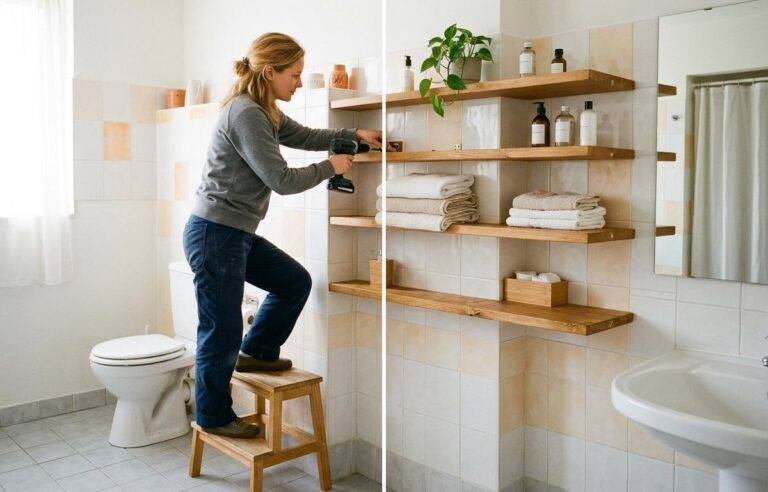
Wall-mounted shelves cover floating shelves and bracketed ledges. They’re for people who want a clean look and are happy to drill, and you choose the height, length and finish yourself. Floating shelves also carry the least visual weight, which helps a small room feel open.
Are floating shelves better than over-toilet cabinets? Neither wins outright. Cabinets hide clutter behind doors and leave your walls alone, while floating shelves look lighter and can go exactly where you want them. If you’d rather start with a ready-made rack, our bathroom storage rack over the toilet shelf is a good place to begin, and the full bathroom shelves collection lets you compare the other styles side by side. For a broader look at matching storage to your room, our guide on home storage organization products walks through the decision.
Advice on shelf height above the toilet conflicts, so it helps to see why. Lowe’s recommends at least 24 inches between the tank lid and the bottom of a cabinet or shelf, so you can lift the lid and avoid bumping your head. Other guides are far more lenient: some say 12–18 inches above the tank, and one gives 10–12 inches above the lid as a minimum. A few suggest setting the bottom shelf around 20 inches up so you can still reach the flapper and fill valve for repairs.
So how high should you hang a shelf above a toilet? Treat 12 inches as the practical floor and 20–24 inches as the comfortable range. At 12 inches you can still lift most tank lids, but it’s a squeeze and a tall person may brush the shelf. At 20–24 inches you get easy tank access and head room, with usable wall left above for a second shelf. If you’re tall, have an older toilet that needs the odd bit of tinkering, or keep a decorative piece on the tank, go for the higher end.
Depth matters just as much. Over-toilet cabinets typically run 7–12 inches deep. For a plain shelf, 9–12 inches holds toilet paper and small baskets without feeling like it looms over your head, while anything past about 18 inches juts out too far for comfort. How wide should floating shelves be above a toilet? Many guides suggest roughly 16–20 inches, about the width of the toilet itself, while others go to 2–3 feet for a more generous ledge. Match the width to your tank rather than to a catalog size, and note which side the flush lever is on so the shelf and its contents never block it.
If one shelf feels too limiting, stack two with a gap between them: a reachable lower tier for daily items, and a higher one for spare towels or decor.
Codes don’t tell you how high to hang a shelf, but they do protect the space around the toilet, and that affects where shelves and tall racks can go. Under the IRC 2024 toilet clearance requirements, you need at least 15 inches from the toilet centerline to any side wall, partition or obstruction, and at least 21 inches of clear space in front of the bowl. The Uniform Plumbing Code, used in some regions, asks for 24 inches in front instead of 21, according to a summary of minimum toilet clearances. These figures come from secondary summaries, so confirm what your local authority requires before a renovation.
The practical lesson is that a deep shelf or tall tower beside the toilet can intrude into that 15-inch side zone. Keep side-mounted storage shallow, or place it further along the wall.
The same placement mistakes come up again and again:
Is it safe to put shelves above the toilet? Yes, when they’re installed properly, stocked sensibly and hung high enough to clear your head. Keep fragile glass and heavy items on lower or more secure shelves, and use baskets or lidded containers for anything that could tumble.
How much weight can a shelf above the toilet hold? One vendor guide puts it at about 15–25 lb when mounted into studs and about 10–15 lb with quality anchors in drywall. Treat those as vendor claims, not tested data, and always check the rating on your specific shelf. A shelf rated for far more is still only as strong as the wall behind it.
That’s why finding studs is the best upgrade you can make. Screwing into a stud gives the shelf real support, while drywall anchors are fine for lighter loads like folded washcloths, a candle or a small plant. Space brackets about 6–8 inches in from each end, and add a center bracket on shelves longer than 36 inches to stop sagging. If you can’t hit a stud, use a good anchor sized to the load and keep the contents light.
Moisture is the other enemy. Standard steel screws and brackets rust in bathroom humidity, so choose stainless or coated hardware. Wood can survive in a bathroom if it’s protected, but the material makes a big difference. Mass-produced MDF shelves tend to swell in steamy rooms, and unfinished pine is a poor bet near a shower. Solid hardwoods with a good sealer fare better, and stainless steel and glass shrug off moisture. One shop guide gives specific lifespans for each material, but those are vendor figures, so use them only as a rough guide.
Can wood floating shelves survive in a bathroom? Yes, if they’re sealed on every surface, including the underside and edges, and the room has decent ventilation. How do you prevent mold on bathroom wood shelves? Run the exhaust fan after showers, wipe up standing water, keep the finish intact and don’t crowd the shelves, so air can circulate. As for the best finish, a durable water-resistant sealer applied in several thin coats is the usual advice. Inside or right beside a shower, skip untreated wood altogether and pick a shelf made for wet zones, such as the options in our guide to choosing shower shelves.
If you can’t drill, you have more choices than you might think. Freestanding over-toilet racks need no wall damage at all, and suction or adhesive shelves can handle light items in the shower or by the sink. A suction cup bathroom shelf suits small loads, while a bathroom shelf kitchen storage organizer can pull double duty if you move. Adhesive and suction products depend heavily on a clean, smooth, non-porous surface, and their weight limits sit well below anything screwed into a stud, so keep them for light, everyday items.
With a freestanding rack, stability is what to check. Look for adjustable feet, a sturdy frame and, ideally, a wall strap or anti-tilt kit, especially if you have kids or pets. Keep the heaviest items on the lowest tier.
Retail snapshots date quickly, but shelves range widely in price. One major home improvement retailer lists bathroom shelves from about $20 to $400, and a well-reviewed three-tier adjustable unit has been cited for under $85. Marketplace freestanding racks turn up even lower. Since prices shift, compare current listings rather than trusting any single figure, and weigh what you get: stainless or coated hardware, a sealed finish and a real weight rating are worth a few extra dollars in a humid room.
Are bathroom shelves over the toilet good for small bathrooms? They’re one of the best uses of space you weren’t using, as long as you respect height and side clearances. For help fitting storage into tight layouts, our guide to home organization ideas for small spaces has more ideas, and if you want a quick look at how stylists approach it, HGTV’s roundup of over-the-toilet storage solutions shows plenty of looks.
How to choose. Start with whether you can drill: if not, pick a freestanding rack or a light adhesive shelf. Measure your tank width, the flush lever side and the wall space, then confirm at least 12 inches above the lid, and ideally 20–24. Keep depth near 9–12 inches, check the weight rating against what you plan to store, and insist on rust-resistant hardware and a sealed finish. When you’re ready to compare, browse our full bathroom shelves range and our wider products page to find the shelf that fits your space and budget.


Leave a comment